Showing posts with label Miscellaneous. Show all posts

May 26, 2008

Unions Go Global

Looks like the US & UK steelworkers unions are going to merge. The United Steelworkers' Union and Unite hope to reach a deal by July to merge the two unions. The combined union will have more than three million members in the UK, US & Canada,

Comments from Andrew Murray, Unite's spokesperson:

"We are dealing with global companies that can move capital - and employment - around the world at will in many cases."

"While big business is global and labour is national, we are going to be at a disadvantage."

Union membership in the US has been on a steady decline, although last year actually saw a growth in membership numbers. UK unions are in a similar decline, yet they still make up a larger percentage of the workforce than in America.

It make sense for unions to want to bulk up, but what is the benefit for a cross border tie-up? It seems that it will set up internal battles amongst the labor leaders from different countries.

US Union Membership as a Share of Wage and Salary Employment

Source: Congressional Budget Office, 2002

UK Union Membership as a Share of Wage and Salary Employment

Source: Department for Business Enterprise & Regulatory Reform, 2006

Source:
'UK And US Unions 'To Join Forces' , by BBC News

May 19, 2008

A Play On League Tables

From a website call Here Is The City, a little play on the league tables that the financial industry uses to measure each other. The premise of the table was to look at the total credit losses firms have written down per banking employee.

Below is a graphic representation of the losses per employee.

End Of The America Empire

From the May 12th Newsweek, there was an article adapted from 'The Post-American World' a book by Fareed Zakaria. It was a rather large article, but well worth reading. One may not agree with every point Mr. Zakaria makes but it does get one thinking about how the world will change in the century that has just started.

Below are a couple of passages of interest:

'Look around. The world's tallest building is in Taipei, and will soon be in Dubai. Its largest publicly traded company is in Beijing. Its biggest refinery is being constructed in India. Its largest passenger airplane is built in Europe. The largest investment fund on the planet is in Abu Dhabi; the biggest movie industry is Bollywood, not Hollywood. Once quintessentially American icons have been usurped by the natives. The largest Ferris wheel is in Singapore. The largest casino is in Macao, which overtook Las Vegas in gambling revenues last year. America no longer dominates even its favorite sport, shopping. The Mall of America in Minnesota once boasted that it was the largest shopping mall in the world. Today it wouldn't make the top ten. In the most recent rankings, only two of the world's ten richest people are American. These lists are arbitrary and a bit silly, but consider that only ten years ago, the United States would have serenely topped almost every one of these categories.'

'These factoids reflect a seismic shift in power and attitudes. It is one that I sense when I travel around the world. In America, we are still debating the nature and extent of anti-Americanism. One side says that the problem is real and worrying and that we must woo the world back. The other says this is the inevitable price of power and that many of these countries are envious—and vaguely French—so we can safely ignore their griping. But while we argue over why they hate us, "they" have moved on, and are now far more interested in other, more dynamic parts of the globe. The world has shifted from anti-Americanism to post-Americanism.'

'We are living through the third great power shift in modern history. The first was the rise of the Western world, around the 15th century. It produced the world as we know it now—science and technology, commerce and capitalism, the industrial and agricultural revolutions. It also led to the prolonged political dominance of the nations of the Western world. The second shift, which took place in the closing years of the 19th century, was the rise of the United States. Once it industrialized, it soon became the most powerful nation in the world, stronger than any likely combination of other nations. For the last 20 years, America's superpower status in every realm has been largely unchallenged—something that's never happened before in history, at least since the Roman Empire dominated the known world 2,000 years ago. During this Pax Americana, the global economy has accelerated dramatically. And that expansion is the driver behind the third great power shift of the modern age—the rise of the rest.'

'At the military and political level, we still live in a unipolar world. But along every other dimension—industrial, financial, social, cultural—the distribution of power is shifting, moving away from American dominance. In terms of war and peace, economics and business, ideas and art, this will produce a landscape that is quite different from the one we have lived in until now—one defined and directed from many places and by many peoples.'

'The underlying reality across the globe is of enormous vitality. For the first time ever, most countries around the world are practicing sensible economics. Consider inflation. Over the past 20 years hyperinflation, a problem that used to bedevil large swaths of the world from Turkey to Brazil to Indonesia, has largely vanished, tamed by successful fiscal and monetary policies. The results are clear and stunning. The share of people living on $1 a day has plummeted from 40 percent in 1981 to 18 percent in 2004 and is estimated to drop to 12 percent by 2015. Poverty is falling in countries that house 80 percent of the world's population. There remains real poverty in the world—most worryingly in 50 basket-case countries that contain 1 billion people—but the overall trend has never been more encouraging. The global economy has more than doubled in size over the last 15 years and is now approaching $54 trillion! Global trade has grown by 133 percent in the same period. The expansion of the global economic pie has been so large, with so many countries participating, that it has become the dominating force of the current era. Wars, terrorism, and civil strife cause disruptions temporarily but eventually they are overwhelmed by the waves of globalization. These circumstances may not last, but it is worth understanding what the world has looked like for the past few decades.'

(America) 'remains the most open, flexible society in the world, able to absorb other people, cultures, ideas, goods, and services. The country thrives on the hunger and energy of poor immigrants. Faced with the new technologies of foreign companies, or growing markets overseas, it adapts and adjusts. When you compare this dynamism with the closed and hierarchical nations that were once superpowers, you sense that the United States is different and may not fall into the trap of becoming rich, and fat, and lazy'

'Washington has gotten used to a world in which all roads led to its doorstep. America has rarely had to worry about benchmarking to the rest of the world—it was always so far ahead. But the natives have gotten good at capitalism and the gap is narrowing. Look at the rise of London. It's now the world's leading financial center—less because of things that the United States did badly than those London did well, like improving regulation and becoming friendlier to foreign capital. Or take the U.S. health care system, which has become a huge liability for American companies. U.S. carmakers now employ more people in Ontario, Canada, than Michigan because in Canada their health care costs are lower. Twenty years ago, the United States had the lowest corporate taxes in the world. Today they are the second-highest. It's not that ours went up. Those of others went down'

One of the biggest points I took away from the artcile is that America and its people will probably do fine in the global shift, as long as the governement doesn't get in the way. Quite frankly between the legislative branch and the executive branch and their constant drive to get re-elected it is amazing this country hasn't fallen further behind the rest of the world.

Source:
'The Rise of the Rest', by Fareed Zakaria, Newsweek Magazine

May 14, 2008

Killing Off Car Maker's Brands

There is a large article in the June issue of Portfolio Magazine on how to save the US car industry. It discusses the problems and potential solutions to reinvigorating the American car makers.

It seems that the former big three, now called the Detroit Three, are stuck in an era when they ruled the industry and had no reason to be innovative. It seems like they have been behind the way in which the industry is moving. It seems that just now are understanding that big SUVs and trucks are hard to sell with gas approaching $4.00 a gallon.

Here is an excerpt from the article:

'How much worse can it get? Try the Dwindling Duo, in which Chrysler is sold to a foreign company—yet again—and smaller versions of G.M. and Ford remain. Or, less likely, the Sole Survivor, in which those two merge out of desperation. The market share the Detroit Three have lost since 2000 is equivalent to a Ford-size company being wiped out. You don’t need higher math to see that such losses aren’t sustainable for long. Another decade like this and the American auto industry could disappear entirely, its factories razed and turned into a lot where people can park all their European- and Asian-made cars.

Yet there is a scenario in which the Detroit companies—at least Ford and G.M.—can emerge somewhat smaller but far stronger. Their size and costs would be based on current realities instead of on pining for the good old days. And their cars would actually be products that people want to buy instead of merely settle for. I’ve been covering the car business for 23 years and have seen corporate crises, ill-conceived acquisitions, boardroom revolts, C.E.O. sackings, and more. Through it all, Detroit’s cycles have been biblical: Prosper, go astray, repent, recover. It’s repentance time now, and there are concrete reasons to believe that the Detroit Three will recover.'

As usual with Portfolio, they have a nice little interactive feature that goes with the story. Below is a screen shot from it, that depicts which brands the article suggests receive the ax.

Source: 'Brands That Should Die', portfolio.com

Unfortunately the auto makers have so many stakeholders and institutional inertia that it will be hard, if not impossible, to make any drastic changes.

Source:
'Who Will Survive?', by Paul Ingrassia, Portfolio Magazine

May 13, 2008

The Immigrant Innovation Boost

Via The New Economist, there is a research paper, by Jennifer Hunt, which shows a link between an vibrant and educated immigrant student population and innovation in the US. A couple of excerpts from the paper:

'Although there is a large literature studying the impact of immigration on the host country, this literature is more focused on potential costs than potential benefits. One reason for this is that the biggest potential benefits are harder to quantify than potential costs. Amongst these potential benefits are higher productivity, if there are increasing returns to scale in production; the achievement of critical mass in specialized areas of research, development and production; spillover effects of skilled workers through externalities and production complementarities, including of the O-ring variety; increased entrepreneurship and increased innovation in science, the arts and other fields. Some tantalizing facts hint at the possible importance of these effects for the United States.'

'Twenty-six percent of U.S.-based Nobel Prize recipients from 1990-2000 were immigrants (Peri 2007), twenty-nine percent of U.S.-based U.S. patent holders had non-Anglophone names in 2000-2004 (Kerr 2007), and twenty-five percent of founders of public venture-backed U.S. companies in 1990-2005 were immigrants (Anderson and Platzer n.d.), compared to a foreign-born population of 12% in 2000.'

'While in the short run there is some evidence that immigrants crowd out natives, either deterring natives from moving to states with skilled immigrants or deterring them from working as a scientist or engineer, in the long run there is no evidence of such crowd-out, but rather a suggestion that skilled immigrants may attract skilled natives. This is consistent with Borjas (2006), who finds that immigrants do not crowd out natives as a whole from graduate school. The absence of crowd-out means that my estimates of the benefits of immigrants are not offset by reductions in native contributions to innovation.'

Below is a chart from the report, which shows the top 4 states with the most patents. Two things these states share are a great number of quality colleges and universities and a large and diverse immigrant population. The odd thing is that aside from Texas, all the other are high tax states.

Source:
'How Much Does Immigration Boost Innovation?', by Jennifer Hunt

April 24, 2008

Are They Worth It?

The NY Times has a great interactive feature on executive compensation in relation to the company's stock price and change in net income.

The feature was part of a special report on executive pay, and how shareholders have been fighting to keep compensation in line by tying it into stock or company performance.

'The compensation research firm Equilar recently compiled data about chief executive pay at 200 companies that filed their proxies by March 28 and had revenues of at least $6.5 billion. (The data) shows that average compensation for chief executives who had held the job at least two years rose 5 percent in 2007, to $11.2 million. '

Source:
'A Brighter Spotlight, Yet the Pay Rises', by Claudia H Deutsch, NY Times
'Executive Pay: The Bottom Line for Those at the Top', NY Times

April 10, 2008

And These Guys Are In Charge?

Saw this on The Weekly Standard website:

Roll Call reports that the Members of Congress who are deciding how to address the depressed housing market and economic slowdown are among those who've lost the most. And one of the contenders for the title of biggest loser is John Kerry:

Congress’ uber-rich had the most at stake. Sen. John Kerry (D-Mass.), who married into the Heinz ketchup fortune, is near the top of Roll Call’s list, with as much as $2.9 million in potential banking stock losses. According to his 2007 disclosure form, Kerry owned at least $1 million apiece in insurer AIG, investment bank Morgan Stanley and mortgage issuer Washington Mutual, whose stock alone has lost 75 percent of its value during the past 15 months.

It's useful to remember that hundreds of Representatives have experienced losses direct and indirect as a result of the slowing economy. Few if any will recuse themselves from voting on legislation that may directly influence their net worth. And if you may have lacked faith in the wisdom of Congress to properly address the slump, check out this:

Cleta Mitchell, a lawyer who works with many GOP Members on their financial disclosure statements, suggested during a conversation about potential pitfalls in disclosing financial information that it's not surprising that nearly 10 percent of lawmakers may be out millions of dollars because of the current credit collapse.

“Frankly ... these people are economically illiterate,” she said.

Economically illiterate, those are fighting words.

Source:
'Kerry Loses Millions', by Michael Goldfarb, The Weekly Standard

April 7, 2008

Geographical Bias

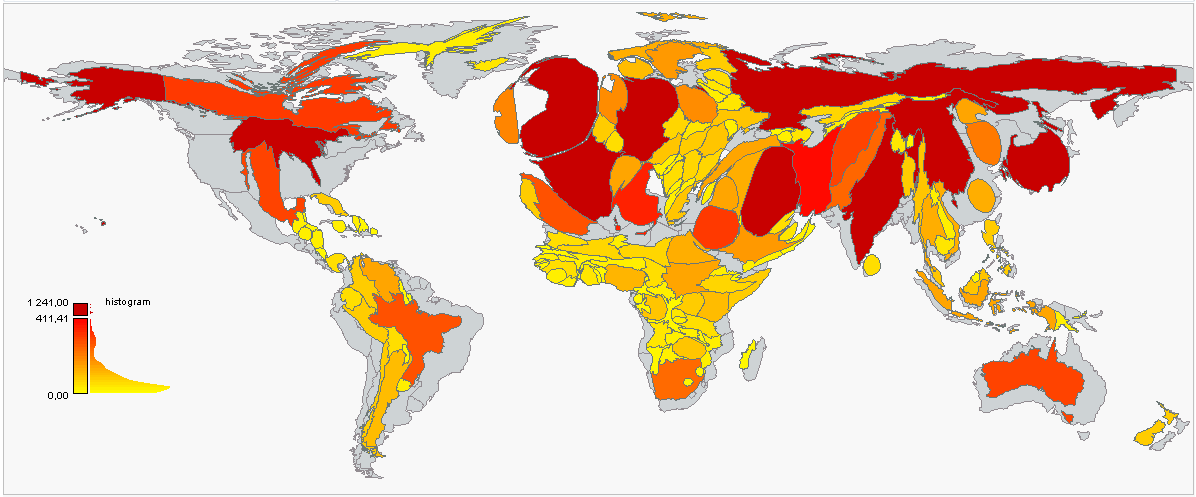
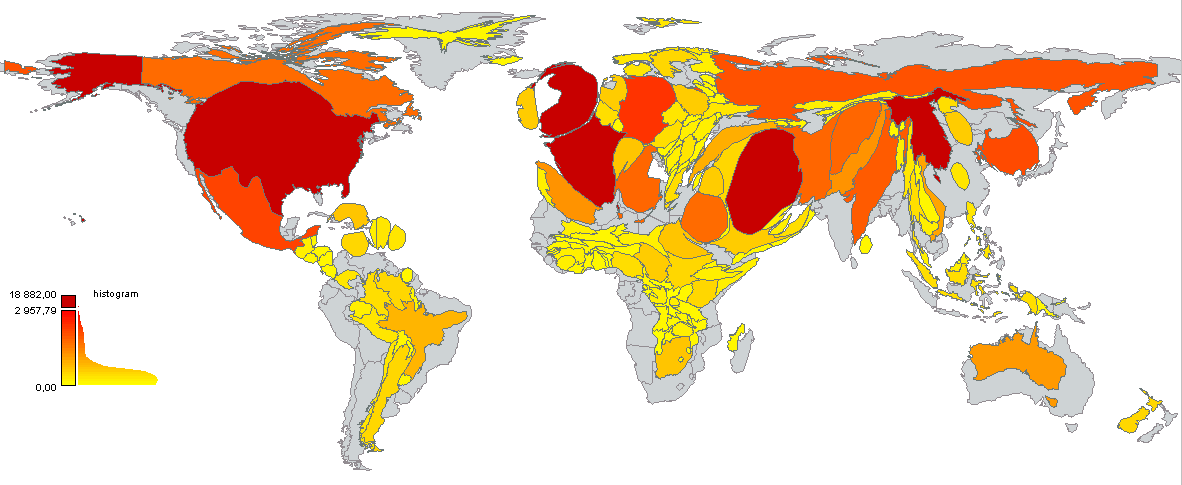
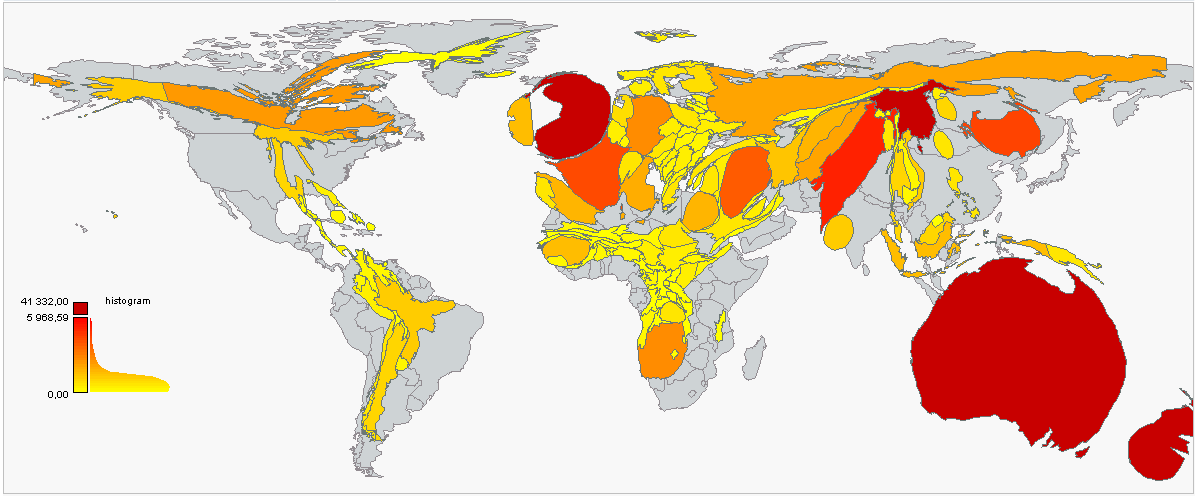
Ran across this while reading the Numbers Guy blog over at blogs.wsj.com. Nicolas Kayser-Bril, a graduate student in media and economics, published a series of maps showing world news coverage for ten 'international' media organizations. The maps show the amount of coverage countries received from the media organization.

There are several problems with the data used to produced the maps, or cartograms. Most of the data was gathered by Mr. Kayser-Bril who went to the websites of the organizations and counted the number of times a country was mentioned in an article published in 2007. Some of the other problems with the data is the difficulty in determining the difference between country names and peoples name (i.e. Chad and Chad Johnson) and some countries have multiple ways of being identified (i.e. England, Great Britain). Even Mr. Kayser-Bril, acknowledges that the maps are not very accurate and were published as a blogger not as a researcher.

Below are some cartograms of The Economist, The New York Times and The Australian:

The Economist

New York Times

The Australian

A couple of totally unrelated points about this:

  1. Think of Others - we tend to think of only those things that are immediately around us. Most of the news lately has been how terrible the US economy is, but what is happening with the rest of the world? Is it as bad as it is here?
  2. Don't Accept Everything At Face Value - while there is probably a lot of truth behind the data Mr Kayser-Bril used to make these maps, there are enough problems with it that requires us think discount it. Enron!
  3. Everything Is Local (this is a corollary to item #1.) - even though the world has shrunk, most people only care about what is immediately around them. Humans have short attention spans.

Source:
"
Why It’s Hard to Map Media Coverage", by Carl Bialik
"
Le monde dans les yeux d’un rédac chef, l’Américaine version", by Nicolas Kayser-Bril

February 21, 2008

Identity Theft

The Postal Service has sent out a letter making people aware of identity theft. The letter says that a recent Federal Trade Commission (FTC) survey indicated that only 2% of all victims reported that the theft of their identity was connected to the mail. The letter included a brochure from the FTC with helpful tips to deter, detect and defend against identity theft. This time of year is always a good time for identity thieves because of all the tax documents being sent out. Its not uncommon to hear stories of people's mail being lifted in order to get personal information contain in the tax documents.

A 2006 report listed the following ways a personal information was obtained:

56% Method not known
16% Personal acquaintances
07% Purchase or other transaction
05% Wallet stolen
05% Company had information stolen
02% Mail
01% Computer theft
01% Phishing
07% Some other way

Useful Links:
FTC web site on Id Theft
Id Theft Center website

February 18, 2008

Forever Stamps

In light of the Postal Service raising postage for first class mail by 1 cent in May of 2008, the concept of the "Forever Stamp" makes more sense for both the USPS and the end user. The USPS created the “Forever Stamp” in April 2007 as a way for consumers to lock in the price of a first-class stamp no matter how much, or how often, the price increases. The Postal Service described the stamp as "a consumer innovation guaranteed to deliver unprecedented convenience and value to our customers."

For the end user, the "Forever Stamp" reduces the hassle of sending mail after a rate change. It seems that whenever rates change, you always have a partial book of stamps at the old rate. If you want to mail something, you have to track down one-cent stamps to make up the difference. This requires a trip to the post office to either wait 10-30 minutes on line to buy stamps, or you end up with a couple of dollar coins in change from the stamp-dispensing machine. Neither one of these sounds like a great option.


The "Forever Stamp" is like a stock option on the increase in postal rates and inflation. The great thing is that this option is always in the money, you are guaranteed to make a "profit". If you buy the "Forever Stamps" as a cheap as possible and hold them longer the larger the profit. Granted the annualized rate of return will probably be something like 2%-4%, not including inflation. Most of the "profit" would come from a reduction in the hassle factor.

The great thing about the "Forever Stamp" for the Postal Service is it that fewer man-hours are required to implement a change in postage rates. When rates change the Post Office probably spends quite a bit of time returning letters that have the incorrect postage on them. If they can get the majority of mailers to use these stamps, imagine how much time and money they can save not having to return letters. The other potential cost savings could come from printing fewer one-cent stamps to make up the difference in postal rates. Overtime the USPS probably makes up for any lost revenue with the "Forever Stamp" on cost savings from labor.

Prices for postcards, large envelopes and packages, will see price increases between one and five cents in May. The price for shipping services including Express Mail and Priority Mail will be announced in the coming months.

For additional information > Stamps Increasing by One Cent to 42¢ on May 12