Showing posts with label 529 Plans. Show all posts

March 3, 2008

Saving For College - Savings Accounts

Saving For College

One of the major life expenses, besides retirement and buying a home, is paying for college. Unfortunately the cost of sending a child to college has increase about twice as fast as inflation, about 5%-8% a year. The College Board issued a news release that the average cost for 2007-2008 at a four-year private college is $23,712/year (up 6.3 percent from last year) and at a four-year public college is $6,185/year (up 6.6 percent from last year). Published tuition and fees can run as high as $33,000/year, however 56 percent of students at four-year schools pay less than $9,000 for tuition and fees per year. A child born today could expect to pay $355,839 for four years at a private college and $92,816 for four years at a public college (calculator).

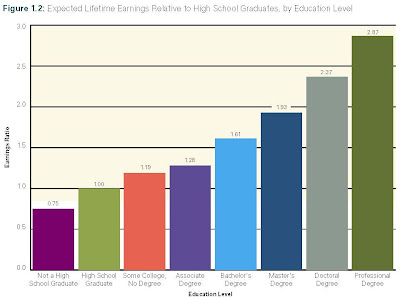
This is a lot of money, however if you view education as an investment in your child's future the costs are reasonable. A 2007 College Board Study, Education Pays, states that

"During their working lives, typical college graduates earn over 60 percent more than typical high school graduates, and those with advanced degrees earn two to three times as much as high school graduates. Salaries are not the only form of compensation correlated with education level; college graduates are more likely than other employees to enjoy employer-provided health and pension benefits. More educated people are less likely to be unemployed and less likely to live in poverty. These economic returns make financing a college education a good investment."

As your degree level increases, so does your total expected lifetime earnings. A master's degree (MBA,eg) is worth 93% more than a high school degree, a doctoral degree (PHD, eg) is worth 137% more, while a professional degree (MD, JD, eg) is worth 187%.
Below is a list of common ways to save for college. Each section will provide a brief summary, along with pros and cons of the methods.

Coverdell Education Savings Account

The Coverdell ESA allows you to make an annual non-deductible contribution to the savings account, which grows federally tax free. Withdrawals for qualified education expenses from the account are also tax free, in most cases. This account is similar, at least from a tax standpoint, as a Roth IRA. The money in the account can be used for accounts can be set up with most banks, brokers or mutual fund companies. This type of account lets you pay for elementary and secondary school expenses, along with other qualified education expenses.

Pros:

  • Flexibility & Investment Choices - can set up ESA with most banks, brokers or mutual fund companies. You can pick your investment choices.
  • Expenses - may be lower than in some state 529 plans.
  • Qualified Education Expenses - include tuition (K-12 and college), fees, tutoring, books, supplies, related equipment, room and board, uniforms, transportation, extended day programs, computers, Internet access.
  • Financial Aid - are treated the same as 529 Savings Plans for financial aid purposes (5.6% counted as a parent's asset).
  • Transferable - funds maybe transferred to other members of your family as long as the meet the age restrictions below.
  • Fees - typically are lower with this type of account.

Cons:

  • Contribution Amount - a total of $2,000 a year per beneficiary.
  • Earnings Restrictions - for modified adjusted gross income levels $95,000 to $110,000 (single) or $190,000 to $220,000 (married filing jointly), contributions will be limited. Over $110,000 (single) or $220,000 (married filing jointly), contributions are not allowed.
  • Age Restrictions - beneficiaries must be under the age of 18 and funds must be used by 30 years old.
  • Market Risk - since money is invested in stocks, bonds or mutual finds, the account could always be worth less than the contribution amount due to market risks.

529 Savings Plan

A 529 Savings Plan, or Qualified Tuition Program (QTP), works similarly to a Coverdell ESA, with some significant differences. A main difference is that these plans are set up by the states and administered by third parties, mainly mutual fund companies. In some states the contributions made to the account can be deducted from state income taxes. The plan will only cover qualified educational expenses for post-secondary education (college), but allows for higher contribution amounts

Pros:

  • Taxes - possible deduction on state income taxes.
  • Contribution Amount - up to $300,000 per beneficiary in many states.
  • Earnings Restrictions - None to very few depending on the state.
  • Age Restrictions - None to very few depending on the state.
  • Financial Aid - if account is owned by parent, the assets are assessed at a maximum rate of 5.64% in determining a student's Expected Family Contribution.

Cons:

  • Flexibility & Investment Choices - stuck using plans set up by the states. Most plans have limited investment choices.
  • Fees - typically higher than over college savings plans.
  • Taxes - can get complicated if contributions exceed the annual gift-tax exclusion of $12,000 per person.
  • Market Risk - since money is invested in stocks, bonds or mutual finds, the account could always be worth less than the contribution amount due to market risks.

529 Pre-Paid Plan

A 529 Pre-Paid Plan, or Qualified Tuition Program (QTP), allows families to purchase tuition at a public college at current cost. There are two types of pre-paid plans, a contract plan and a unit plan. A contract plan lets you purchase contracts for one to five years of tuition. A unit plan let you purchase 'units' which could be equal to credit hours or a percentage of a years tuition. Contributions can be made either as a lump sum or over a period of time.

Pros:

  • Market Risk - none,you are guaranteed by the state to at least match in-state tuition increases.
  • Transferable - most programs allow funds to be transferred to private or out-of-state schools. You are responsible for paying the difference in tuition rates.

Cons:

  • Flexibility - stuck using the state plan, geared towards state schools and often restricted to in-state residents.
  • Refund/Cancellation Fees - can be required to pay high penalties to cancel plan.
  • Qualified Education Expenses - limited to tuition and fees in most states.
  • Financial Aid - may significantly impact the ability to secure financial aid.

UTMA/UGMA

A uniform Transfer to Minors Act or Uniform Gifts to Minors Act accounts are an account set up on behalf of a minor. The child is the owner of the account upon reaching the 'age of majority'. so they can do as they please with the money. Their plans for the money may not include college.

Pros:

  • Earnings Restrictions - none.
  • Flexibility & Investment Choices - can set up a UTMA/UGMA with most banks, brokers or mutual fund companies. You can pick your investment choices.
  • Taxes - account is taxed at the child's income tax rate.

Cons:

  • Control - Once child reaches age of majority, they control the money.
  • Taxes - can get complicated if contributions exceed the annual gift-tax exclusion of $12,000 per person.
  • Financial Aid - account is owned by student, the assets have a larger impact on financial aid eligibility. Could make it more difficult to secure financial aid.
  • Irrevocable - money to fund to account is deemed an irrevocable gift and can not be transferred back to the parent.
  • Legal - these accounts require more legal understanding than other types of accounts. This link has a good explanation of UTMA/UGMAs.

This list is not exhaustive and there are other savings methods that could be used to save for college. Most of these other are not specific to saving for education, and do not have some of the same benefits as those listed above.

Three critical points to take away from this post:

  1. Start Early - As with any savings goal, the earlier you start the better. There are tons of articles and studies out there illustrating this point.
  2. Not One Account for All - You should evaluate which account is best for you. In some cases a single type of account may not be the best
  3. Your Retirement - Don't short change your retirement accounts to fund your child's education. Worse case, your child has to take out student loans to attend school. In the long run paying back the loan will be cheaper than having to fund a parent's retirement.

Source
http://www.collegeboard.com/parents/csearch/know-the-options/21385.html
http://www.collegeboard.com/prod_downloads/about/news_info/trends/ed_pays_2007.pdf
http://finance.yahoo.com/college-education/article/101867/A_Crash_Course_in_College_Savings_Plans
http://www.irs.gov/publications/p970/index.html

Helpful Links
http://www.collegeboard.com/parents/pay/
http://www.finaid.org/
http://www.finaid.org/calculators/costprojector.phtml

February 22, 2008

An Introduction to 529 Plans

What is a 529 plan?

A 529 plan is a tax-advantaged savings plan designed to encourage saving for future college costs. 529 plans, legally known as “qualified tuition plans,” are sponsored by states, state agencies, or educational institutions and are authorized by Section 529 of the Internal Revenue Code.

There are two types of 529 plans: pre-paid tuition plans and college savings plans. All fifty states and the District of Columbia sponsor at least one type of 529 plan. In addition, a group of private colleges and universities sponsor a pre-paid tuition plan.

What are the differences between pre-paid tuition plans and college savings plans?

Pre-paid tuition plans generally allow college savers to purchase units or credits at participating colleges and universities for future tuition and, in some cases, room and board. Most prepaid tuition plans are sponsored by state governments and have residency requirements. Many state governments guarantee investments in pre-paid tuition plans that they sponsor.

College savings plans generally permit a college saver (also called the “account holder”) to establish an account for a student (the “beneficiary”) for the purpose of paying the beneficiary’s eligible college expenses. An account holder may typically choose among several investment options for his or her contributions, which the college savings plan invests on behalf of the account holder. Investment options often include stock mutual funds, bond mutual funds, and money market funds, as well as, age-based portfolios that automatically shift toward more conservative investments as the beneficiary gets closer to college age. Withdrawals from college savings plans can generally be used at any college or university. Investments in college savings plans that invest in mutual funds are not guaranteed by state governments and are not federally insured.

The following chart outlines some of the major differences between pre-paid tuition plans and college savings plans.1

Prepaid Tuition PlanCollege Savings Plan

Locks in tuition prices at eligible public and private colleges and universities.

No lock on college costs.

All plans cover tuition and mandatory fees only. Some plans allow you to purchase a room & board option or use excess tuition credits for other qualified expenses.

Covers all "qualified higher education expenses," including:

  • Tuition
  • Room & board
  • Mandatory fees
  • Books, computers (if required)

Most plans set lump sum and installment payments prior to purchase based on age of beneficiary and number of years of college tuition purchased.

Many plans have contribution limits in excess of $200,000.

Many state plans guaranteed or backed by state.

No state guarantee. Most investment options are subject to market risk. Your investment may make no profit or even decline in value.

Most plans have age/grade limit for beneficiary.

No age limits. Open to adults and children.

Most state plans require either owner or beneficiary of plan to be a state resident.

No residency requirement. However, nonresidents may only be able to purchase some plans through financial advisers or brokers.

Most plans have limited enrollment period.

Enrollment open all year.


1 Source: Smart Saving for College, FINRA®

How does investing in a 529 plan affect federal and state income taxes?

Investing in a 529 plan may offer college savers special tax benefits. Earnings in 529 plans are not subject to federal tax, and in most cases, state tax, so long as you use withdrawals for eligible college expenses, such as tuition and room and board.

However, if you withdraw money from a 529 plan and do not use it on an eligible college expense, you generally will be subject to income tax and an additional 10% federal tax penalty on earnings. Many states offer state income tax or other benefits, such as matching grants, for investing in a 529 plan. But you may only be eligible for these benefits if you participate in a 529 plan sponsored by your state of residence. Just a few states allow residents to deduct contributions to any 529 plan from state income tax returns.

If you receive state tax benefits for investing in a 529 plan, make sure you review your plan’s offering circular before you complete a transaction, such as rolling money out of your home state’s plan into another state’s plan. Some transactions may have state tax consequences for residents of certain states.

What fees and expenses will I pay if I invest in a 529 plan?

It is important to understand the fees and expenses associated with 529 plans because they lower your returns. Fees and expenses will vary based on the type of plan. Prepaid tuition plans typically charge enrollment and administrative fees. In addition to “loads” for broker-sold plans, college savings plans may charge enrollment fees, annual maintenance fees, and asset management fees. Some of these fees are collected by the state sponsor of the plan, and some are collected by the financial services firms that the state sponsor typically hires to manage its 529 program. Some college savings plans will waive or reduce some of these fees if you maintain a large account balance or participate in an automatic contribution plan, or if you are a resident of the state sponsoring the 529 plan. Your asset management fees will depend on the investment option you select. Each investment option will typically bear a portfolio-weighted average of the fees and expenses of the mutual funds and other investments in which it invests. You should carefully review the fees of the underlying investments because they are likely to be different for each investment option.

Investors that purchase a college savings plan from a broker are typically subject to additional fees. If you invest in a broker-sold plan, you may pay a “load.” Broadly speaking, the load is paid to your broker as a commission for selling the college savings plan to you. Broker-sold plans also charge an annual distribution fee (similar to the “12b 1 fee” charged by some mutual funds) of between 0.25% and 1.00% of your investment. Your broker typically receives all or most of these annual distribution fees for selling your 529 plan to you.

Many broker-sold 529 plans offer more than one class of shares, which impose different fees and expenses. Here are some key characteristics of the most common 529 plan share classes sold by brokers to their customers:

  • Class A shares typically impose a front-end sales load. Front-end sales loads reduce the amount of your investment. For example, let’s say you have $1,000 and want to invest in a college savings plan with a 5% front-end load. The $50 sales load you must pay is deducted from your $1,000, and the remaining $950 is invested in the college savings plan. Class A shares usually have a lower annual distribution fee and lower overall annual expenses than other 529 share classes. In addition, your front-end load may be reduced if you invest above certain threshold amounts – this is known as a breakpoint discount. These discounts do not apply to investments in Class B or Class C shares.

  • Class B shares typically do not have a front-end sales load. Instead, they may charge a fee when you withdraw money from an investment option, known as a deferred sales charge or “back-end load.” A common back-end load is the “contingent deferred sales charge” or “contingent deferred sales load” (also known as a “CDSC” or “CDSL”). The amount of this load will depend on how long you hold your investment and typically decreases to zero if you hold your investment long enough. Class B shares typically impose a higher annual distribution fee and higher overall annual expenses than Class A shares. Class B shares usually convert automatically to Class A shares if you hold your shares long enough.
    • Be careful when investing in Class B shares. If the beneficiary uses the money within a few years after purchasing Class B shares, you will almost always pay a contingent deferred sales charge or load in addition to higher annual fees and expenses.

  • Class C shares might have an annual distribution fee, other annual expenses, and either a front- or back-end sales load. But the front- or back-end load for Class C shares tends to be lower than for Class A or Class B shares, respectively. Class C shares typically impose a higher annual distribution fee and higher overall annual expenses than Class A shares, but, unlike Class B shares, generally do not convert to another class over time. If you are a long-term investor, Class C shares may be more expensive than investing in Class A or Class B shares.

Is there any way to purchase a 529 plan but avoid some of the extra fees?

Direct-Sold College Savings Plans. States offer college savings plans through which residents and, in many cases, non-residents can invest without paying a "load," or sales fee. This type of plan, which you can buy directly from the plan's sponsor or program manager without the assistance of a broker, is generally less expensive because it waives or does not charge sales fees that may apply to broker-sold plans. You can generally find information on a direct-sold plan by contacting the plan’s sponsor or program manager or visiting the plan’s website. Websites such as the one maintained by the College Savings Plan Network, as well as a number of commercial websites, provide links to most 529 plan websites.

Broker-Sold College Savings Plans. If you prefer to purchase a broker-sold plan, you may be able to reduce the front-end load for purchasing Class A shares if you invest or plan to invest above certain threshold amounts. Ask your broker how to qualify for these “breakpoint discounts.”

What restrictions apply to an investment in a 529 plan?

Withdrawal restrictions apply to both college savings plans and pre-paid tuition plans. With limited exceptions, you can only withdraw money that you invest in a 529 plan for eligible college expenses without incurring taxes and penalties. In addition, participants in college savings plans have limited investment options and are not permitted to switch freely among available investment options. Under current tax law, an account holder is only permitted to change his or her investment option one time per year. Additional limitations will likely apply to any 529 plan you may be considering. Before you invest in a 529 plan, you should read the plan’s offering circular to make sure that you understand and are comfortable with any plan limitations.

Does investing in a 529 plan impact financial aid eligibility?

While each educational institution may treat assets held in a 529 plan differently, investing in a 529 plan will generally reduce a student’s eligibility to participate in need-based financial aid. Beginning July 1, 2006, assets held in pre-paid tuition plans and college savings plans will be treated similarly for federal financial aid purposes. Both will be treated as parental assets in the calculation of the expected family contribution toward college costs. Previously, benefits from pre-paid tuition plans were not treated as parental assets and typically reduced need-based financial aid on a dollar for dollar basis, while assets held in college savings plans received more favorable financial aid treatment.

Is investing in a 529 plan right for me?

Before you start saving specifically for college, you should consider your overall financial situation. Instead of saving for college, you may want to focus on other financial goals like buying a home, saving for retirement, or paying off high interest credit card bills. Remember that you may face penalties or lose benefits if you do not use the money in a 529 account for higher education expenses. If you decide that saving specifically for college is right for you, then the next step is to determine whether investing in a 529 plan is your best college saving option. Investing in a 529 plan is only one of several ways to save for college. Other tax-advantaged ways to save for college include Coverdell education savings accounts, Uniform Gifts to Minors Act (“UGMA”) accounts, Uniform Transfers to Minors Act (“UTMA”) accounts, tax-exempt municipal securities, and savings bonds. Saving for college in a taxable account is another option.

Each college saving option has advantages and disadvantages, and may have a different impact on your eligibility for financial aid, so you should evaluate each option carefully. If you need help determining which options work best for your circumstances, you should consult with your financial professional or tax advisor before you start saving.

What questions should I ask before I invest in a 529 plan?

Knowing the answers to these questions may help you decide which 529 plan is best for you.

  • Is the plan available directly from the state or plan sponsor?
  • What fees are charged by the plan? How much of my investment goes to compensating my broker? Under what circumstances does the plan waive or reduce certain fees?
  • What are the plan’s withdrawal restrictions? What types of college expenses are covered by the plan? Which colleges and universities participate in the plan?
  • What types of investment options are offered by the plan? How long are contributions held before being invested?
  • Does the plan offer special benefits for state residents? Would I be better off investing in my state’s plan or another plan? Does my state’s plan offer tax advantages or other benefits for investment in the plan it sponsors? If my state’s plan charges higher fees than another state’s plan, do the tax advantages or other benefits offered by my state outweigh the benefit of investing in another state’s less expensive plan?
  • What limitations apply to the plan? When can an account holder change investment options, switch beneficiaries, or transfer ownership of the account to another account holder?
  • Who is the program manager? When does the program manager’s current management contract expire? How has the plan performed in the past?

Source:
Above is information on
529 plans from the SEC website.

Useful Links:
http://www.savingforcollege.com/
http://www.kiplinger.com/features/archives/2007/08/best529s.html