Showing posts with label Savings. Show all posts

May 2, 2008

Stimulus Payments & Consumer Spending

The first round of tax stimulus checks have made their way to some Americans. The question is will Americans spend these checks and if they do what will they buy.

Consumer Spending

The Fed released consumer spending numbers that showed a marginal growth in consumer spending. The report showed a 0.4 percent increase in March, if inflation is taken into account the increase was more like 0.1%. From a NY Times article:

'Most of the money that was spent went toward services, including necessities like haircuts and medical care. Sales of big-ticket items like washing machines and television sets declined in March, the report said, a signal that Americans were putting off large-scale purchases, which are commonly bought on credit. In the first quarter, sales of those goods plummeted 6.1 percent.'

The report also showed that the average Americans income rose just 0.3 percent, barely keeping up with the monthly inflation rate and taxes. This was a drop from the 0.5% increase the month before.

Stimulus Checks

Congress passed the economic stimulus plan earlier this year. The plan was meant to boost the ailing US economy by prodding Americans to spend. (This type of economic 'stimulus' has been a favorite of the Administration and of Congress. They seem to think that we can spend our way out of any economic problem.)

If anything the boost will be short lived, and may not provide that much stimulation to the economy. A report issued by Parks Associates, indicates that 42% of the people they polled plan on saving their money due to the uncertainty with the economy.

Where Will The Checks Go

CNN.com has a series of articles on what 'ordinary' Americans plan to do with the stimulus checks.

Better yet, I like this journalists ideas:

  • Put your money where your mouth is by donating your entire check to your favorite presidential candidate, or even your favorite local politician's war chest. So, John Q. Patriot, do you really support Barack, Hillary or McCain? Prove it.
  • Guarantee a fine dining experience at your favorite eatery each month by paying up front and asking for a discount on drinks. Just think, $1,200 will get you and your wife into that swanky joint once a month for a year simply by saying, "Put it on my tab."
  • Buy that new bicycle or mo-ped you'll soon need for local errands when gas prices get truly ridiculous.
  • (H)ost your very own Economic Stimulus Act Block Party in your neighborhood and invite only those poor souls who didn't get a check from Uncle Sam.

Source:
'For a 4th Month, Shoppers Curtail the Desire to Spend', by Michael M Grynbaum, NY Times
'Consumers Saving Rebate Checks', by Laura Palotie, Inc.com
'Rebate checks: How to spend '' CNN.com
'Stimulating Ideas On How To Spend a Stimulus Check', by Jerry Davich, Post-Tribune

April 11, 2008

Dollar Cost Average or Lump Sum

Dollar cost averaging or lump sum, which is the best approach for an investor. The unequivocal answer is either one depending on your situation.

Basic Investment Strategies

Below is a brief explanation of the two investment strategies. Have also thrown in another strategy that is similar to dollar cost averaging.

Dollar Cost Averaging (DCA) is defined as the investment strategy of buying a fixed dollar amount of a particular investment on a regular schedule, regardless of the share price. More shares are purchased when prices are low, and fewer shares are bought when prices are high. An example of this type of investing is to purchase $1,000 of shares each month to in a mutual fund for a total of $12,000 over a year.

Lump Sum Investing (LSI) is defined as the investment strategy of buying a particular investment at one time. An example of this type of investing is entering in an order to purchase $12,000 worth of shares at a single time. Typically additional purchases would not be made in a significant amount.

Value Averaging (VA) is defined as an investing strategy that works much like dollar cost averaging (DCA) in terms of steady monthly contributions, but differs in its approach to the amount of each monthly contribution. In value averaging, the investor sets a target growth rate or amount on his or her asset base or portfolio each month, and then adjusts the next month's contribution according to the relative gain or shortfall made on the original asset base. An example of this type of investing is to start by purchasing a set number of shares, and over a period of a time purchasing additional shares each month so that the account value equals $12,000. The number of shares would vary depending on the price of the shares. Months when the price is lower than the intital purchase price, more shares would be bought and the opposite when prices are higher.

Which Strategy Yields The Best Returns?

Using historical data to compare the DCA strategy to the LSI strategy, the LSI method returns higher results 2 out of 3 times. Here is a tool that allows you to test the two methods for each month of the year since 1950. LSI has the advantage since the overall trend of the stock market has been to increase in value year to year. In a rising stock market, DCA is hurt by the fact that with each purchase the cost basis of the shares increases while the LSI cost basis remains constant. Typically in a market that is in a down trend, the DCA strategy comes out ahead because with each purchase the cost basis is lowered.

Below is a chart from AllFinancialMatters.com, that compares DCA strategy to LSI strategy. The LSI strategy (account value) took $19,900 and invested in the Vanguard S&P 500 Index fund on January 2, 1990. The DCA strategy invested $100 at the begining of each month from January 2, 1990 to July 3, 2006, which works out to a total of $19,900 (199 months multipled by $100 each month).

Practical Advice

If you come into a large amount of money and want to invest it, you are better off putting it on all at one time. First is the evidence clearly shows that in most cases you will come out ahead by lump-sum investing. Secondly if you invest it all at one time, you will not be tempted to spend it.

Most of us cannot afford to take a large sum of money at one time and invest it, by default we have to dollar-cost average. An employee sponsered retirement plan (401K or 403B) is a perfect example of dollar-cost averaging. If this is the only way that you can afford to invest, this is your best option.

Source:
'Dollar Cost Averaging', Investopedia.com
'Value Averaging', Investopedia.com
'
Dollar Cost Averaging v. Lump Sum Investing - Part II', by JLP, allfinancialmatters.com
'Lump Sum Beats Dollar-Cost Averaging' by Richard E. Williams, Ph.D., and Peter W. Bacon, DBA, CFP, Journal of Financial Planning

April 10, 2008

Simple Investment Advice

There is a ton of information and advice out there on how to build wealth. It seems that some people try to attain wealth by developing a 'system' on how to be rich, then write a book on the 'system' and finally give seminars on how the 'system' works. A long the way there are plenty of opportunities for selling 'system' merchandise. The problem with this is that each 'system' needs a little different angle to make it stand out from all the other stuff out there. All of these different angles end up creating a lot of noise and confusion, when really most systems talk about the same basic things.

I guess if I were to write a book on how to build wealth I would write about these six pieces of advice. Eventually I will have to come up with a fancy buzz word, which would be trademarked, to describe my powerful wealth building system, but these things just seem like common sense.

Just think, I have already started you on your way to building your wealth. By finding this you just saved $9.99 plus tax for my book.

1. Start Now

The sooner you start to invest the better your long term returns will be due to the power of time (and compounding). Time is one of the best investment tools you will ever have. Below is a chart, from AG Edwards, that compares an early saver and a late saver. The early saver deposits $250 a month for 10 years for a total investment of $30,000, while the late saver waits 10 years and then begins to deposit $250 a month for 30 years for a total investment of $90,000. Assuming an 8% compounded return and ignoring taxes, at the end of 40 years the early saver has $88,000 more than the late saver. If the earlier saver continued to save $250 a month for the entire 40 years the difference between the two savers would be much greater.

Source: AGEdwards.com

Don't worry about the hottest stocks or sectors to be in. Don't worry about not having enough money to begin. Don't worry about being too young or too old. Don't worry about how much you need to save. Just start.

2. Compounding is Your Friend

Albert Einstein has been quoted as saying "The most powerful force in the universe is compound interest." In the case of investing in stocks and mutual funds you are really compounding your returns, but the idea is similar to compound interest. As you reinvest your dividends and capital gains distributions back into your stocks or mutual funds, this reinvestment generates additional earnings which grow year after year. Below is a chart, from Bankrate.com, showing that if at age 25 you started to put $100 per month into an account that returns 6% each year that you would have $200,145.

Source: Bankrate.com

The great thing about compounding is that the growth you get from reinvesting the dividends and capital gains distributions will start to outpace the return you get from your initial investment. Think of it as a small snowball rolling down a mountain. As the snowball rolls down the hill it picks up more and more snow, building in size. At the bottom of the mountain the snowball has grown in size to a massive one (a bit of an exaggeration but you get the idea). Eventually you reach a point where your money is working for you to create more money. This is the 'holy grail' for investors.

3. Your Only Average

You should just come out and say this 'I am not as good of an investor as I think I am'. Numerous studies have been performed showing that people tend to be overly optimistic when it comes to investment decisions. This over optimism leads people to sell their winning investments too soon and hold onto their losing investments too long. If you are able to take the emotion out of your investing, and accept that you are only average you will come out ahead of many others. From a NY Times article:

Stocks have been a great investment in the last 80 years, with an average return of about 10 percent a year. But have investors in the stock market done as well as stocks? Surprisingly, the answer is no. The average dollar invested in the stock market in those years has earned only about 8.6 percent a year.

The article references a paper published by Ilia D. Dichev, a University of Michigan accounting professor, that explains the difference due to investors buying patterns. The article provides an example:

To understand the difference between a stock’s return and an investor’s return, consider someone who buys 100 shares of a company at a price of $10 a share. A year later, the share price is up to $20, and the investor buys 100 more shares.

Alas, the investor’s luck has run out. By the end of the next year, the price has fallen back to $10 and the investor sells his 200 shares. A buy-and-hold investor who bought at $10, held the stock for two years, and then sold at $10 would have had a zero return.

But our friend who tried to time the market did much worse: over the two years, he invested $3,000 in the stock and ended up with only $2,000. Even though the stock broke even, the investor lost money because of bad timing: most of his money was invested right before the market fell.

To calculate a meaningful measure of the investor’s return, it is necessary to weight the yearly returns by the dollars invested during that year. When Mr. Dichev calculates the dollar-weighted returns on this stock according to his preferred method, our hypothetical investor’s average yearly return ends up being negative 26.8 percent, far below the zero return that the buy-and-hold investor would have received.

4. Invest for The Long Term / Invest Through All Markets

Shorter time periods in the stock market are very volatile, however the general trend for most stock markets has been in an upward direction. The market will fluctuate from day to day, month to month and year to year, the market can not be up making a new high everyday.

Source: yahoo.com

Above is a chart of the S&P 500 starting in 1950 through today, compared to the 10-year US Bond. Since 1950 there have been 12 bear markets with an average loss of -26%. Over the same period the S&P 500 has returned over 7,500%. During those 12 bear markets it probably seemed like the world was ending, however the market rebounded from these events. Granted markets do not go up all the time and there maybe periods of under performance, however being invested in the stock market is a great way to build wealth.

5. Keep It Simple, Be Lazy

There is no need to spend a lot of time developing a complex portfolio of stock, bond and mutual fund holdings. The easiest way to be invested in the market and to be diversified is to invest in a Life Style or Target Retirement fund. These types of funds are a one-stop-fund that invest in a basket of stock and bond mutual funds, shifting overtime from more stocks in the early years to more bonds as the 'target' age is reached. These funds will even re-balance as needed to maintain their asset allocations, all you would need to do is fund the investment. Granted these types of investments are not a lot of fun to talk about at a cocktail party, but in the long run they will save you time, effort and worry. Below is a chart comparing a very simple portfolio (Second Garder's Starter), a target retirement fund (T Rowe Price 2040 Fund) and the S&P 500.

Portfolio

Equity %

1 Year Return (3)

3 Year Annualized Return (3)

5 Year Annualized Return (3)

Second Grader's Starter (1)

90%

8.83%

12.31%

17.02%

S&P 500 (1)

100%

5.49%

8.62%

12.83%

T Rowe Price 2040 Fund (2)

91%

6.67%

10.31%

14.76%

1) Source: Morningstar Inc
2) Source: T Rowe Price
3) Returns as of 01/03/2008

For more information see my posts on being a lazy investor, part one and part two.

6. Make It Automatic

Sign up for an automatic investment plan. The most common of these plans is a 401K or other employee-sponsored retirement plan you might find at work. These plans work by automatically taking money from your pay check and investing them into your account. You don't even get a chance to spend the money. You are paying yourself first.

Another great thing about automatic investment plans is that you are dollar-cost averaging (DCA). Dollar cost averaging is a 'technique of buying a fixed dollar amount of a particular investment on a regular schedule, regardless of the share price. More shares are purchased when prices are low, and fewer shares are bought when prices are high.'

There is some controversy about DCA and that it is nothing more than a marketing gimmick. Some studies have shown that over 'long periods, dollar-cost averaging almost always produces lower returns than investing lump sums in diversified portfolios, and almost never reduces risk meaningfully.' The studies are correct, if one were able to invest lump sums they would come out ahead, but who has a nice lump sum sitting around?

Probably the most important lesson to take away is that it takes discipline and commitment to build wealth. Very few people are lucky enough to win the lottery, to have developed and marketed a must-have gadget or worked hard starting their own company which has been bought out for millions of dollars. Most of us have the save and invest diligently, live within or means and let time help us out. But it is possible if you just start now.

Source:
'Sometimes the Stock Does Better Than the Investor That Buys the Stock',by Hal R Varian, New York Times
'Dollar-Cost Averaging', Investopedia.com
'The costly myth of dollar-cost averaging', by Timothy Middleton, MSNMoney.com

April 9, 2008

Jonathan Clements is Retiring

Read in the WSJ that after 26 years as a journalist Jonathan Clements is retiring. He has decided to take his mom's advice and is getting a real job, although he doesn't go onto explain what that real job will be.

His last article asks "What is the reason for all this saving and investing?" He provides three key benefits.

1. If you have money, you don't have to worry about it. This isn't guaranteed. There are lots of rich folks who agonize constantly -- and needlessly -- about their finances. Still, if you save diligently, you should reach the point where money worries are relatively rare.

This feeling of financial serenity isn't, however, only for the wealthy. If you live beneath your means and invest prudently, you can achieve a sense of financial control long before you achieve full financial independence.

As I see it, this is yet another reason to follow my favorite investment strategy, which is to build a globally diversified portfolio of low-cost index funds.

If you are diversified, you don't have to fret about your wealth imploding because of a few disastrous stocks or a single rotten market. And if you buy index funds, you don't have to worry about badly lagging behind the market averages because you or your fund managers pick the wrong stocks.

2. Money can give you the freedom to pursue your passions. Ideally, you want to spend your days engaged in activities that you find absorbing and satisfying, that you feel you're good at -- and where you feel you're doing good.

Indeed, the happiest retirees are typically those who have a sense of purpose, whether it's volunteering for their pet cause, coaching a children's sports team, helping their church or returning to long-neglected studies. Retirement gives them a chance to pursue their passions without worrying about a paycheck.

But again, you don't need to be financially independent to have a sense of purpose. If you're young, you can pick a career that is close to your heart. If you're in your 40s and you have been saving for 15 or 20 years, maybe you can afford to swap into a new job that is less lucrative but more fulfilling.

3. Money can buy you time with friends and family. You don't just need a reason to get up in the morning. You also need somebody to come home to at night.

Studies have found that regularly seeing friends and family can provide a huge boost to happiness. Money helps in this regard, allowing you to go out to dinner with neighbors, travel to see old friends, take your family on vacation and go to the theater with your spouse. If you don't need to work or you only work part time, that will help further, giving you more hours to share with the folks you like best.

I have always enjoied reading Mr Clements articles. He has some keen observations on personal finance and how to build your wealth.

Source:
'Parting Shot: What I Learned From Writing 1,008 Columns' , by Jonathan Clements, WSJ {$$$}

April 8, 2008

Changing Jobs - Don't Forget Your 401K

Back in the 60's most people went to work for one compay and stayed with that company until they retired. Today the job market seems to be constantly changing. The U.S. Department of Labor figures show that the youngest baby boomers (ages 42–49) have, on average, held more than 10 different jobs during their careers.

Below is a chart From Charles Schwab listing the options you have when it comes to your 401K plan:

Option

ProsCons
Roll over to new employer's plan
  • Avoid early withdrawal penalties.
  • Money continues to grow tax-deferred.
  • May have a limited number of investment choices
  • May have limited ability to make exchanges among funds in your plan.
Roll over to an IRA
  • Avoid early withdrawal penalties.
  • Money continues to grow tax-deferred.
  • Offers more options than employer plan.
  • Can't borrow against the assets.
  • May have to pay an annual fee.
Leave in former employer's plan
  • Avoid early withdrawal penalties.
  • Money continues to grow tax-deferred.
  • Retain the ability to roll over to an IRA or new employer's plan at a later date.
  • Can no longer contribute to former employer's plan.
  • May have a limited number of investment choices.
  • May have limited ability to make exchanges among funds in your plan.
Take a cash distribution
  • Can provide cash when facing extraordinary financial difficulties.
  • If you are younger than age 59½, you'll face a 10% early withdrawal tax penalty and a 20% federal mandatory tax withholding.
  • Money no longer grows tax-deferred.
  • You may face goal short-fall risk—the risk that you won't have enough money for retirement.

Source:
'Managing Your Finances When Changing Jobs' , by Charles Schwab & Co., Inc.


March 24, 2008

Debit - Not Just A US Problem

Seems that running up a ton of consumer debit is not isolated to the US. Britain has experience a run up in consumer debit levels that exceed those of the US. Britions have a debit to income ratio of 1.62, compared to 1.42 in the US and 1.09 in Germany. Consumer debit in England is greater than its GDP, which estimated for 2007 at $2.2 trillion dollars. The US consumer has run up $13.8 trillion dollars just below its GDP at $14 trillion.

A rather striking passage from a New York Times article:

“The housing boom automatically made people feel richer than they actually were and people went on to use the equity locked up in their property almost as a bank account they can dip into every time they want to buy a new car,” (Liz) Bingham, (head of restructuring at Ernst & Young in London), said.

As the perception of wealth grew, the social stigma around debt disappeared. Borrowing became such an accepted part of life that today one in five teenagers does not consider being in debt to be a bad thing, a survey by Nationwide Building Society showed.

Debt levels increased further as it became easier to get loans, and retailers, like computer chain PC World, offered both goods and the loans to buy them. Consumers happily accepted, thinking that as long as they were deemed creditworthy, they were not in danger of defaulting.

Sounds very similar to the way the US consumer has treated debit.

Its seems strange that if someone thinks or feels that they are rich, they are more inclined to spend money or take on debit. This perception of wealth seems to be rooted in a sense of entitlement and eternal optimism. People have warped their logic so that if they perceive they are rich they are entitled to look or act rich. Or they have been able to rationilze that they can spend the money now, because in the future some how more money will appear. All of which seems to fly in the face of how true wealth is built.

Source:
"
Debt-Gorged British Start to Worry That the Party Is Ending", Julia Werdigier, NY Times

March 5, 2008

Saving For College - Tax Incentives

As a follow-up to an earlier post about saving for college, below are some tax incentives that the IRS has in place.

HOPE Credit

A parent may claim the HOPE credit for 100% of the first $1,100 and 50% of the next $1,100 of college tuition and mandatory fees for each dependant child, up to a maximum of $1,650 (TY2007) annual tax credit per child who paid at least $2,200 in qualified education expenses (QEE) for a maximum of two years. This credit phases out for modified adjusted gross incomes (MAGI)between $47,000 and $57,000 for single filers and between $94,000 and $114,000 for a joint return.

Some limitations on the credit, the student must be pursing an undergraduate degree or otherwise recognized education credential and must be enrolled at least half time for at least one academic period. This credit is available to students only after they have completed the first two years of post secondary education, and is available only for two years per student.

Lifetime Learning Credit

The Lifetime Learning Credit can be claimed by a taxpayer for QEE for an eligible student. The IRS defines an eligible student as either yourself, your spouse or a dependent. The credit is 20% of the first $10,000 of QEE, with the maximum credit claimed of $2,000 (TY 2007) per year. This credit phases out for MAGI between $47,000 and $57,000 for single filers and between $94,000 and $114,000 for a joint return.

The advantages of this credit over the HOPE credit are:

  • Available for all years of postsecondary education and for courses to acquire or improve job skills.

  • Available for an unlimited number of years.

  • Student does not need to be pursuing a degree or otherwise recognized education credential.

  • Available for one or more courses.

You can be eligible for both the HOPE credit and the Lifetime Learning Credit in a single tax year, but cannot claim both. The IRS indicates that for most tax payers if their total qualified education expenses for a student are more than $8,250, it will generally be in their benefit to claim the lifetime learning credit. Below is a table comparing the two credits.

Lifetime Learning Credit Hope Credit
Up to $2,000 credit per returnUp to $1,650 credit per eligible student
Available for all years of postsecondary education and for courses to acquire or improve job skills Available ONLY until the first 2 years of post-
secondary education are completed
Available for an unlimited number of years Available ONLY for 2 years per eligible student
Student does not need to be pursuing a degree or other recognized education credential Student must be pursuing an undergraduate degree or other recognized education credential
Available for one or more courses Student must be enrolled at least half time for at least one academic period beginning during the year
Felony drug conviction rule does not apply No felony drug conviction on student's record

Student Loan Interest Deduction

You can claim a deduction for student loan interest payments of $2,500 or the actual interest you paid which ever is less (TY2007). This deduction is phased out for MAGI between $55,000 and $70,000 for single filers and between $110,000 and $140,000 for a joint return. The IRS defines an eligible student as either yourself, your spouse or a dependent and enrolled at least half-time in a degree program. This deduction is available for as long you have the loan. In order to take the deduction the loan must be a qualified student loan used for qualified educational expenses.

Tuition and Fees Deduction

The Tuition and Fees Deduction can be claimed by a taxpayer for QEE for an eligible student. The IRS defines an eligible student as either yourself, your spouse or a dependent. The amount deducted is on a three tiered system:

IF your filing status is... AND your MAGI is... THEN your maximum tuition and fees deduction is...
single,

head of household,
or
not more than $65,000 $4,000.
more than $65,000
but not more than $80,000
$2,000.
qualifying widow(er) more than $80,000 $0.
married filing joint return not more than $130,000 $4,000.
more than $130,000
but not more than $160,000
$2,000.
more than $160,000 $0.

No Double Benefit

For all of these tax incentives, you are not allowed a double benefit. You cannot:

  • Deduct qualified education expenses you deduct under any other provision of the law, for example, as a business expense.
  • Deduct qualified education expenses for a student on your income tax return if you or anyone else claims a Hope or lifetime learning credit for that same student in the same year.

  • Deduct qualified education expenses that have been used to figure the tax-free portion of a distribution from a Coverdell education savings account (ESA) or a qualified tuition program (QTP). For a QTP, this applies only to the amount of tax-free earnings that were distributed, not to the recovery of contributions to the program. See Figuring the Taxable Portion of a Distribution in chapter 7 (Coverdell ESA) and in chapter 8 (QTP).

  • Deduct qualified education expenses that have been paid with tax-free interest on U.S. savings bonds (Form 8815). See Figuring the Tax-Free Amount in chapter 10.

  • Deduct qualified education expenses that have been paid with tax-free scholarship, grant, or employer- provided educational assistance. See the following section on Adjustments to Qualified Education Expenses.

Not a Tax Adviser

All of the tax incentives may seem a little confusing, and they are. But if you spend some time reading through the IRS publication and seek advice from a professional tax advisor, there are some nice benefits that the government allows.

Sources:
http://www.irs.gov/publications/p970/index.html
http://www.savingforcollege.com/tutorial101/federal_tax_incentives_to_education.php

March 3, 2008

Saving For College - Savings Accounts

Saving For College

One of the major life expenses, besides retirement and buying a home, is paying for college. Unfortunately the cost of sending a child to college has increase about twice as fast as inflation, about 5%-8% a year. The College Board issued a news release that the average cost for 2007-2008 at a four-year private college is $23,712/year (up 6.3 percent from last year) and at a four-year public college is $6,185/year (up 6.6 percent from last year). Published tuition and fees can run as high as $33,000/year, however 56 percent of students at four-year schools pay less than $9,000 for tuition and fees per year. A child born today could expect to pay $355,839 for four years at a private college and $92,816 for four years at a public college (calculator).

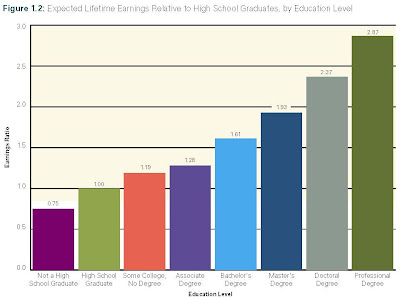
This is a lot of money, however if you view education as an investment in your child's future the costs are reasonable. A 2007 College Board Study, Education Pays, states that

"During their working lives, typical college graduates earn over 60 percent more than typical high school graduates, and those with advanced degrees earn two to three times as much as high school graduates. Salaries are not the only form of compensation correlated with education level; college graduates are more likely than other employees to enjoy employer-provided health and pension benefits. More educated people are less likely to be unemployed and less likely to live in poverty. These economic returns make financing a college education a good investment."

As your degree level increases, so does your total expected lifetime earnings. A master's degree (MBA,eg) is worth 93% more than a high school degree, a doctoral degree (PHD, eg) is worth 137% more, while a professional degree (MD, JD, eg) is worth 187%.

Below is a list of common ways to save for college. Each section will provide a brief summary, along with pros and cons of the methods.

Coverdell Education Savings Account

The Coverdell ESA allows you to make an annual non-deductible contribution to the savings account, which grows federally tax free. Withdrawals for qualified education expenses from the account are also tax free, in most cases. This account is similar, at least from a tax standpoint, as a Roth IRA. The money in the account can be used for accounts can be set up with most banks, brokers or mutual fund companies. This type of account lets you pay for elementary and secondary school expenses, along with other qualified education expenses.

Pros:

  • Flexibility & Investment Choices - can set up ESA with most banks, brokers or mutual fund companies. You can pick your investment choices.
  • Expenses - may be lower than in some state 529 plans.
  • Qualified Education Expenses - include tuition (K-12 and college), fees, tutoring, books, supplies, related equipment, room and board, uniforms, transportation, extended day programs, computers, Internet access.
  • Financial Aid - are treated the same as 529 Savings Plans for financial aid purposes (5.6% counted as a parent's asset).
  • Transferable - funds maybe transferred to other members of your family as long as the meet the age restrictions below.
  • Fees - typically are lower with this type of account.

Cons:

  • Contribution Amount - a total of $2,000 a year per beneficiary.
  • Earnings Restrictions - for modified adjusted gross income levels $95,000 to $110,000 (single) or $190,000 to $220,000 (married filing jointly), contributions will be limited. Over $110,000 (single) or $220,000 (married filing jointly), contributions are not allowed.
  • Age Restrictions - beneficiaries must be under the age of 18 and funds must be used by 30 years old.
  • Market Risk - since money is invested in stocks, bonds or mutual finds, the account could always be worth less than the contribution amount due to market risks.

529 Savings Plan

A 529 Savings Plan, or Qualified Tuition Program (QTP), works similarly to a Coverdell ESA, with some significant differences. A main difference is that these plans are set up by the states and administered by third parties, mainly mutual fund companies. In some states the contributions made to the account can be deducted from state income taxes. The plan will only cover qualified educational expenses for post-secondary education (college), but allows for higher contribution amounts

Pros:

  • Taxes - possible deduction on state income taxes.
  • Contribution Amount - up to $300,000 per beneficiary in many states.
  • Earnings Restrictions - None to very few depending on the state.
  • Age Restrictions - None to very few depending on the state.
  • Financial Aid - if account is owned by parent, the assets are assessed at a maximum rate of 5.64% in determining a student's Expected Family Contribution.

Cons:

  • Flexibility & Investment Choices - stuck using plans set up by the states. Most plans have limited investment choices.
  • Fees - typically higher than over college savings plans.
  • Taxes - can get complicated if contributions exceed the annual gift-tax exclusion of $12,000 per person.
  • Market Risk - since money is invested in stocks, bonds or mutual finds, the account could always be worth less than the contribution amount due to market risks.

529 Pre-Paid Plan

A 529 Pre-Paid Plan, or Qualified Tuition Program (QTP), allows families to purchase tuition at a public college at current cost. There are two types of pre-paid plans, a contract plan and a unit plan. A contract plan lets you purchase contracts for one to five years of tuition. A unit plan let you purchase 'units' which could be equal to credit hours or a percentage of a years tuition. Contributions can be made either as a lump sum or over a period of time.

Pros:

  • Market Risk - none,you are guaranteed by the state to at least match in-state tuition increases.
  • Transferable - most programs allow funds to be transferred to private or out-of-state schools. You are responsible for paying the difference in tuition rates.

Cons:

  • Flexibility - stuck using the state plan, geared towards state schools and often restricted to in-state residents.
  • Refund/Cancellation Fees - can be required to pay high penalties to cancel plan.
  • Qualified Education Expenses - limited to tuition and fees in most states.
  • Financial Aid - may significantly impact the ability to secure financial aid.

UTMA/UGMA

A uniform Transfer to Minors Act or Uniform Gifts to Minors Act accounts are an account set up on behalf of a minor. The child is the owner of the account upon reaching the 'age of majority'. so they can do as they please with the money. Their plans for the money may not include college.

Pros:

  • Earnings Restrictions - none.
  • Flexibility & Investment Choices - can set up a UTMA/UGMA with most banks, brokers or mutual fund companies. You can pick your investment choices.
  • Taxes - account is taxed at the child's income tax rate.

Cons:

  • Control - Once child reaches age of majority, they control the money.
  • Taxes - can get complicated if contributions exceed the annual gift-tax exclusion of $12,000 per person.
  • Financial Aid - account is owned by student, the assets have a larger impact on financial aid eligibility. Could make it more difficult to secure financial aid.
  • Irrevocable - money to fund to account is deemed an irrevocable gift and can not be transferred back to the parent.
  • Legal - these accounts require more legal understanding than other types of accounts. This link has a good explanation of UTMA/UGMAs.

This list is not exhaustive and there are other savings methods that could be used to save for college. Most of these other are not specific to saving for education, and do not have some of the same benefits as those listed above.

Three critical points to take away from this post:

  1. Start Early - As with any savings goal, the earlier you start the better. There are tons of articles and studies out there illustrating this point.
  2. Not One Account for All - You should evaluate which account is best for you. In some cases a single type of account may not be the best
  3. Your Retirement - Don't short change your retirement accounts to fund your child's education. Worse case, your child has to take out student loans to attend school. In the long run paying back the loan will be cheaper than having to fund a parent's retirement.

Source
http://www.collegeboard.com/parents/csearch/know-the-options/21385.html
http://www.collegeboard.com/prod_downloads/about/news_info/trends/ed_pays_2007.pdf
http://finance.yahoo.com/college-education/article/101867/A_Crash_Course_in_College_Savings_Plans
http://www.irs.gov/publications/p970/index.html

Helpful Links
http://www.collegeboard.com/parents/pay/
http://www.finaid.org/
http://www.finaid.org/calculators/costprojector.phtml

February 29, 2008

Why An Emergency Fund - Follow Up

Found a website that talks about the importance of saving for an emergencies.

"This is a sound choice. Having an emergency savings fund may be the most important difference between those who manage to stay afloat and those who are sinking financially"
They recommend an amount between $500 to $1,000 as a savings goal to start with. The website also offers a program uou can enroll in to help you meet your savings goal. The website also provides information on other savings goals.

"Are you ready to take charge of your financial future? America Saves is here to help. Enrolled savers receive the American Saver newsletter which offers information on a wide variety of savings topics and it will introduce you to other Savers who are achieving their financial goals. We’ll also provide email access to free financial planning advice and best of all – America Saves will motivate you to discover for yourself the peace of mind that accompanies having money in the bank. Let us help you build wealth, not debt"
Source
http://americasaves.org/

February 28, 2008

Why An Emergency Fund?

One of the most important steps to maintaining financial security is to establish an emergency fund. Building and emergency fund, along with paying down debt and reducing monthly expenditures, is probably one of the things most recommended by financial experts.

What Is An Emergency Fund?

An emergency fund is money that is set aside for emergency expenditures. The money should be in an accessible location, preferable a bank account and not under your mattress. You want the money available if you need it, not laying around so you can spend it.

A quick definition of what constitutes an emergency expenditure: car repairs, home repairs, medical expenses, expenses if you lose your job, or other large unplanned expense. A trip to NYC for a weekend of shopping is not an emergency. Without an emergency fund you may be forced to charge these emergency expenses to your credit cards and take on additional debt, putting you further behind.

How Much Should Be In Your Emergency Fund?

Most experts agree that anywhere between three to six months worth of living expenses should be in the emergency fund. If you are single with no dependants, you probable could get away with 2-4 months worth of expenses saved away. If you are married with a couple of kids you probably want to have 6-8 months worth of expenses. The more people dependant on you the more you should have in the account.

No one ever talks about if there is an upper limit to the amount you have in an emergency fund, but anything over 8 months is probably too much to put away in just a bank account. If you feel the need to have over 8 months of savings look to put some of the money in a conservative allocation mutual fund or a CD ladder.

As your life changes; marriage, kids, divorce, retirement for example, it would be good to review your expenses and compare that to the amount in your emergency fund. Even if you do not experience a change with your living situation, you should review your budget yearly and adjust your emergency fund accordingly.

Where To Keep Your Emergency Fund

The best place to keep the emergency fund is in an account that is separate from your normal savings or checking accounts. A critical requirement for the emergency fund is that the money is accessible or liquid, so get an account with check writing privileges, an ATM card or web/phone access for fund transfers. If you think you may spend the money too easily, get an account at a local bank with teller access only.

Below is a list of account types for an emergency fund with pros and cons:

Account Type

Pros

Cons

Checking Account

Very Liquid

Unlimited Access

FDIC Insured

Low Interest Rate

Potential for Monthly Charges

Savings Account

Very Liquid

Unlimited Access

FDIC Insured

Low Interest Rate

Potential for Monthly Charges

Money Market Account

Liquid

Slightly Better Interest Rates

FDIC Insured

Limited Transactions

Money Market Fund

Liquid

Better Interest Rates

Limited Transactions

Not FDIC Insured

Could Lose Money (Market Risk)

CD

Better Interest Rates

FDIC Insured

Not Liquid

Conservative Allocation Mutual Fund

Better Returns

Not FDIC Insured

Not Liquid

Could Lose Money (Market Risk)

Management Fees


No single account is the best for all people all of the time. If you have a small emergency fund, sticking with a bank or savings account probably makes the most sense. As you build your emergency fund look to a money market account or a money market fund.

How To Build An Emergency Fund

As with all things financial there is no quick scheme to build up with an emergency fund. It is best to plan for the entire amount that you need for your emergency fund and develop a plan to save that amount. If you estimate that you need $10,000 to cover 3 months of expenses, calculate what you can save each month to determine how long it will take you to build-up those funds. You will probably find that it may take a couple of years to save the entire amount. Don't worry, the important thing is to start. (A caveat to this, remember to re-evaluate the amount that you need each year. You may find that your expenses increase over time.)

The best way is to have a set amount of money each paycheck go towards your emergency fund. Over the course of a couple of months you can build a fund worth a couple hundred dollars. As you get additional money by working overtime, income from hobbies, birthday/holiday checks or selling things, put all of that money into the emergency fund.

What are you planning on doing with your tax rebate or stimulus package check?

February 22, 2008

An Introduction to 529 Plans

What is a 529 plan?

A 529 plan is a tax-advantaged savings plan designed to encourage saving for future college costs. 529 plans, legally known as “qualified tuition plans,” are sponsored by states, state agencies, or educational institutions and are authorized by Section 529 of the Internal Revenue Code.

There are two types of 529 plans: pre-paid tuition plans and college savings plans. All fifty states and the District of Columbia sponsor at least one type of 529 plan. In addition, a group of private colleges and universities sponsor a pre-paid tuition plan.

What are the differences between pre-paid tuition plans and college savings plans?

Pre-paid tuition plans generally allow college savers to purchase units or credits at participating colleges and universities for future tuition and, in some cases, room and board. Most prepaid tuition plans are sponsored by state governments and have residency requirements. Many state governments guarantee investments in pre-paid tuition plans that they sponsor.

College savings plans generally permit a college saver (also called the “account holder”) to establish an account for a student (the “beneficiary”) for the purpose of paying the beneficiary’s eligible college expenses. An account holder may typically choose among several investment options for his or her contributions, which the college savings plan invests on behalf of the account holder. Investment options often include stock mutual funds, bond mutual funds, and money market funds, as well as, age-based portfolios that automatically shift toward more conservative investments as the beneficiary gets closer to college age. Withdrawals from college savings plans can generally be used at any college or university. Investments in college savings plans that invest in mutual funds are not guaranteed by state governments and are not federally insured.

The following chart outlines some of the major differences between pre-paid tuition plans and college savings plans.1

Prepaid Tuition PlanCollege Savings Plan

Locks in tuition prices at eligible public and private colleges and universities.

No lock on college costs.

All plans cover tuition and mandatory fees only. Some plans allow you to purchase a room & board option or use excess tuition credits for other qualified expenses.

Covers all "qualified higher education expenses," including:

  • Tuition
  • Room & board
  • Mandatory fees
  • Books, computers (if required)

Most plans set lump sum and installment payments prior to purchase based on age of beneficiary and number of years of college tuition purchased.

Many plans have contribution limits in excess of $200,000.

Many state plans guaranteed or backed by state.

No state guarantee. Most investment options are subject to market risk. Your investment may make no profit or even decline in value.

Most plans have age/grade limit for beneficiary.

No age limits. Open to adults and children.

Most state plans require either owner or beneficiary of plan to be a state resident.

No residency requirement. However, nonresidents may only be able to purchase some plans through financial advisers or brokers.

Most plans have limited enrollment period.

Enrollment open all year.


1 Source: Smart Saving for College, FINRA®

How does investing in a 529 plan affect federal and state income taxes?

Investing in a 529 plan may offer college savers special tax benefits. Earnings in 529 plans are not subject to federal tax, and in most cases, state tax, so long as you use withdrawals for eligible college expenses, such as tuition and room and board.

However, if you withdraw money from a 529 plan and do not use it on an eligible college expense, you generally will be subject to income tax and an additional 10% federal tax penalty on earnings. Many states offer state income tax or other benefits, such as matching grants, for investing in a 529 plan. But you may only be eligible for these benefits if you participate in a 529 plan sponsored by your state of residence. Just a few states allow residents to deduct contributions to any 529 plan from state income tax returns.

If you receive state tax benefits for investing in a 529 plan, make sure you review your plan’s offering circular before you complete a transaction, such as rolling money out of your home state’s plan into another state’s plan. Some transactions may have state tax consequences for residents of certain states.

What fees and expenses will I pay if I invest in a 529 plan?

It is important to understand the fees and expenses associated with 529 plans because they lower your returns. Fees and expenses will vary based on the type of plan. Prepaid tuition plans typically charge enrollment and administrative fees. In addition to “loads” for broker-sold plans, college savings plans may charge enrollment fees, annual maintenance fees, and asset management fees. Some of these fees are collected by the state sponsor of the plan, and some are collected by the financial services firms that the state sponsor typically hires to manage its 529 program. Some college savings plans will waive or reduce some of these fees if you maintain a large account balance or participate in an automatic contribution plan, or if you are a resident of the state sponsoring the 529 plan. Your asset management fees will depend on the investment option you select. Each investment option will typically bear a portfolio-weighted average of the fees and expenses of the mutual funds and other investments in which it invests. You should carefully review the fees of the underlying investments because they are likely to be different for each investment option.

Investors that purchase a college savings plan from a broker are typically subject to additional fees. If you invest in a broker-sold plan, you may pay a “load.” Broadly speaking, the load is paid to your broker as a commission for selling the college savings plan to you. Broker-sold plans also charge an annual distribution fee (similar to the “12b 1 fee” charged by some mutual funds) of between 0.25% and 1.00% of your investment. Your broker typically receives all or most of these annual distribution fees for selling your 529 plan to you.

Many broker-sold 529 plans offer more than one class of shares, which impose different fees and expenses. Here are some key characteristics of the most common 529 plan share classes sold by brokers to their customers:

  • Class A shares typically impose a front-end sales load. Front-end sales loads reduce the amount of your investment. For example, let’s say you have $1,000 and want to invest in a college savings plan with a 5% front-end load. The $50 sales load you must pay is deducted from your $1,000, and the remaining $950 is invested in the college savings plan. Class A shares usually have a lower annual distribution fee and lower overall annual expenses than other 529 share classes. In addition, your front-end load may be reduced if you invest above certain threshold amounts – this is known as a breakpoint discount. These discounts do not apply to investments in Class B or Class C shares.

  • Class B shares typically do not have a front-end sales load. Instead, they may charge a fee when you withdraw money from an investment option, known as a deferred sales charge or “back-end load.” A common back-end load is the “contingent deferred sales charge” or “contingent deferred sales load” (also known as a “CDSC” or “CDSL”). The amount of this load will depend on how long you hold your investment and typically decreases to zero if you hold your investment long enough. Class B shares typically impose a higher annual distribution fee and higher overall annual expenses than Class A shares. Class B shares usually convert automatically to Class A shares if you hold your shares long enough.
    • Be careful when investing in Class B shares. If the beneficiary uses the money within a few years after purchasing Class B shares, you will almost always pay a contingent deferred sales charge or load in addition to higher annual fees and expenses.

  • Class C shares might have an annual distribution fee, other annual expenses, and either a front- or back-end sales load. But the front- or back-end load for Class C shares tends to be lower than for Class A or Class B shares, respectively. Class C shares typically impose a higher annual distribution fee and higher overall annual expenses than Class A shares, but, unlike Class B shares, generally do not convert to another class over time. If you are a long-term investor, Class C shares may be more expensive than investing in Class A or Class B shares.

Is there any way to purchase a 529 plan but avoid some of the extra fees?

Direct-Sold College Savings Plans. States offer college savings plans through which residents and, in many cases, non-residents can invest without paying a "load," or sales fee. This type of plan, which you can buy directly from the plan's sponsor or program manager without the assistance of a broker, is generally less expensive because it waives or does not charge sales fees that may apply to broker-sold plans. You can generally find information on a direct-sold plan by contacting the plan’s sponsor or program manager or visiting the plan’s website. Websites such as the one maintained by the College Savings Plan Network, as well as a number of commercial websites, provide links to most 529 plan websites.

Broker-Sold College Savings Plans. If you prefer to purchase a broker-sold plan, you may be able to reduce the front-end load for purchasing Class A shares if you invest or plan to invest above certain threshold amounts. Ask your broker how to qualify for these “breakpoint discounts.”

What restrictions apply to an investment in a 529 plan?

Withdrawal restrictions apply to both college savings plans and pre-paid tuition plans. With limited exceptions, you can only withdraw money that you invest in a 529 plan for eligible college expenses without incurring taxes and penalties. In addition, participants in college savings plans have limited investment options and are not permitted to switch freely among available investment options. Under current tax law, an account holder is only permitted to change his or her investment option one time per year. Additional limitations will likely apply to any 529 plan you may be considering. Before you invest in a 529 plan, you should read the plan’s offering circular to make sure that you understand and are comfortable with any plan limitations.

Does investing in a 529 plan impact financial aid eligibility?

While each educational institution may treat assets held in a 529 plan differently, investing in a 529 plan will generally reduce a student’s eligibility to participate in need-based financial aid. Beginning July 1, 2006, assets held in pre-paid tuition plans and college savings plans will be treated similarly for federal financial aid purposes. Both will be treated as parental assets in the calculation of the expected family contribution toward college costs. Previously, benefits from pre-paid tuition plans were not treated as parental assets and typically reduced need-based financial aid on a dollar for dollar basis, while assets held in college savings plans received more favorable financial aid treatment.

Is investing in a 529 plan right for me?

Before you start saving specifically for college, you should consider your overall financial situation. Instead of saving for college, you may want to focus on other financial goals like buying a home, saving for retirement, or paying off high interest credit card bills. Remember that you may face penalties or lose benefits if you do not use the money in a 529 account for higher education expenses. If you decide that saving specifically for college is right for you, then the next step is to determine whether investing in a 529 plan is your best college saving option. Investing in a 529 plan is only one of several ways to save for college. Other tax-advantaged ways to save for college include Coverdell education savings accounts, Uniform Gifts to Minors Act (“UGMA”) accounts, Uniform Transfers to Minors Act (“UTMA”) accounts, tax-exempt municipal securities, and savings bonds. Saving for college in a taxable account is another option.

Each college saving option has advantages and disadvantages, and may have a different impact on your eligibility for financial aid, so you should evaluate each option carefully. If you need help determining which options work best for your circumstances, you should consult with your financial professional or tax advisor before you start saving.

What questions should I ask before I invest in a 529 plan?

Knowing the answers to these questions may help you decide which 529 plan is best for you.

  • Is the plan available directly from the state or plan sponsor?
  • What fees are charged by the plan? How much of my investment goes to compensating my broker? Under what circumstances does the plan waive or reduce certain fees?
  • What are the plan’s withdrawal restrictions? What types of college expenses are covered by the plan? Which colleges and universities participate in the plan?
  • What types of investment options are offered by the plan? How long are contributions held before being invested?
  • Does the plan offer special benefits for state residents? Would I be better off investing in my state’s plan or another plan? Does my state’s plan offer tax advantages or other benefits for investment in the plan it sponsors? If my state’s plan charges higher fees than another state’s plan, do the tax advantages or other benefits offered by my state outweigh the benefit of investing in another state’s less expensive plan?
  • What limitations apply to the plan? When can an account holder change investment options, switch beneficiaries, or transfer ownership of the account to another account holder?
  • Who is the program manager? When does the program manager’s current management contract expire? How has the plan performed in the past?

Source:
Above is information on
529 plans from the SEC website.

Useful Links:
http://www.savingforcollege.com/
http://www.kiplinger.com/features/archives/2007/08/best529s.html