March 5, 2008

Declining Homes Prices - Don't Worry Ben's Here To Help

Could not believe this story. I heard it on the radio yesterday but did not pay much attention to it. I thought that there is no way the head of the Federal Reserve would suggest that lenders magically reduce loan amounts for some people who owe more than what their house is worth. But he did, as reported in the New York Times:

The chairman of the Federal Reserve, Ben S. Bernanke, urged mortgage lenders and investors on Tuesday to reduce the principal on loans for many people whose homes are no longer worth as much as the amount they still have to repay.

Noting that delinquency and foreclosure rates have soared over the last year, and that housing prices have not stopped falling, the Fed chairman warned that efforts by the government and by industry to prevent foreclosures had not gone far enough.

“Although lenders and servicers have scaled up their efforts and adopted a wide variety of loss mitigation techniques, more can, and should, be done,” Mr. Bernanke said in a speech to a conference of community bankers in Florida.

Though the Fed chairman did not explicitly endorse a new government rescue effort, he stepped up public pressure on the industry to take more drastic measures to keep people from walking away from homes when their mortgages exceed the value of their property.

“When the mortgage is ‘underwater,’ a reduction in principal may increase the expected payoff by reducing the risk of default and foreclosure,” Mr. Bernanke said. The Fed chairman warned that a large and growing number of recent home buyers now owe more than the value of their homes and may have no incentive to keep making payments.

Seems that Ben and Henry are quite seeing eye-to-eye on this thing. The NY Times article continues:

(T)he Fed chairman’s remarks were at odds with the position staked out in recent days by Henry M. Paulson Jr., the secretary of the Treasury.

Mr. Paulson, who has pushed the industry to freeze interest rates for at least some subprime borrowers whose low teaser rates are about to expire, drew a clear distinction between helping people who could not keep up with rising monthly payments and helping people who, because of falling house prices, had no equity in their homes.

“While these equity considerations clearly impact homeowners’ financial situation, they are not the primary concern in the effort to prevent avoidable foreclosures,” Mr. Paulson said on Monday.

Not sure how writing off principal solves anything except making the problem worse for the mortgage lenders now. If the principal is reduce on a home and lets say the housing market recovers briskly over the next couple of years, when there is a profit on the sale of that home who gets the profit?

Source:
http://www.nytimes.com/2008/03/04/business/04cnd-fed.html

Text of Speech:
http://www.federalreserve.gov/newsevents/speech/bernanke20080304a.htm

Saving For College - Tax Incentives

As a follow-up to an earlier post about saving for college, below are some tax incentives that the IRS has in place.

HOPE Credit

A parent may claim the HOPE credit for 100% of the first $1,100 and 50% of the next $1,100 of college tuition and mandatory fees for each dependant child, up to a maximum of $1,650 (TY2007) annual tax credit per child who paid at least $2,200 in qualified education expenses (QEE) for a maximum of two years. This credit phases out for modified adjusted gross incomes (MAGI)between $47,000 and $57,000 for single filers and between $94,000 and $114,000 for a joint return.

Some limitations on the credit, the student must be pursing an undergraduate degree or otherwise recognized education credential and must be enrolled at least half time for at least one academic period. This credit is available to students only after they have completed the first two years of post secondary education, and is available only for two years per student.

Lifetime Learning Credit

The Lifetime Learning Credit can be claimed by a taxpayer for QEE for an eligible student. The IRS defines an eligible student as either yourself, your spouse or a dependent. The credit is 20% of the first $10,000 of QEE, with the maximum credit claimed of $2,000 (TY 2007) per year. This credit phases out for MAGI between $47,000 and $57,000 for single filers and between $94,000 and $114,000 for a joint return.

The advantages of this credit over the HOPE credit are:

  • Available for all years of postsecondary education and for courses to acquire or improve job skills.

  • Available for an unlimited number of years.

  • Student does not need to be pursuing a degree or otherwise recognized education credential.

  • Available for one or more courses.

You can be eligible for both the HOPE credit and the Lifetime Learning Credit in a single tax year, but cannot claim both. The IRS indicates that for most tax payers if their total qualified education expenses for a student are more than $8,250, it will generally be in their benefit to claim the lifetime learning credit. Below is a table comparing the two credits.

Lifetime Learning Credit Hope Credit
Up to $2,000 credit per returnUp to $1,650 credit per eligible student
Available for all years of postsecondary education and for courses to acquire or improve job skills Available ONLY until the first 2 years of post-
secondary education are completed
Available for an unlimited number of years Available ONLY for 2 years per eligible student
Student does not need to be pursuing a degree or other recognized education credential Student must be pursuing an undergraduate degree or other recognized education credential
Available for one or more courses Student must be enrolled at least half time for at least one academic period beginning during the year
Felony drug conviction rule does not apply No felony drug conviction on student's record

Student Loan Interest Deduction

You can claim a deduction for student loan interest payments of $2,500 or the actual interest you paid which ever is less (TY2007). This deduction is phased out for MAGI between $55,000 and $70,000 for single filers and between $110,000 and $140,000 for a joint return. The IRS defines an eligible student as either yourself, your spouse or a dependent and enrolled at least half-time in a degree program. This deduction is available for as long you have the loan. In order to take the deduction the loan must be a qualified student loan used for qualified educational expenses.

Tuition and Fees Deduction

The Tuition and Fees Deduction can be claimed by a taxpayer for QEE for an eligible student. The IRS defines an eligible student as either yourself, your spouse or a dependent. The amount deducted is on a three tiered system:

IF your filing status is... AND your MAGI is... THEN your maximum tuition and fees deduction is...
single,

head of household,
or
not more than $65,000 $4,000.
more than $65,000
but not more than $80,000
$2,000.
qualifying widow(er) more than $80,000 $0.
married filing joint return not more than $130,000 $4,000.
more than $130,000
but not more than $160,000
$2,000.
more than $160,000 $0.

No Double Benefit

For all of these tax incentives, you are not allowed a double benefit. You cannot:

  • Deduct qualified education expenses you deduct under any other provision of the law, for example, as a business expense.
  • Deduct qualified education expenses for a student on your income tax return if you or anyone else claims a Hope or lifetime learning credit for that same student in the same year.

  • Deduct qualified education expenses that have been used to figure the tax-free portion of a distribution from a Coverdell education savings account (ESA) or a qualified tuition program (QTP). For a QTP, this applies only to the amount of tax-free earnings that were distributed, not to the recovery of contributions to the program. See Figuring the Taxable Portion of a Distribution in chapter 7 (Coverdell ESA) and in chapter 8 (QTP).

  • Deduct qualified education expenses that have been paid with tax-free interest on U.S. savings bonds (Form 8815). See Figuring the Tax-Free Amount in chapter 10.

  • Deduct qualified education expenses that have been paid with tax-free scholarship, grant, or employer- provided educational assistance. See the following section on Adjustments to Qualified Education Expenses.

Not a Tax Adviser

All of the tax incentives may seem a little confusing, and they are. But if you spend some time reading through the IRS publication and seek advice from a professional tax advisor, there are some nice benefits that the government allows.

Sources:
http://www.irs.gov/publications/p970/index.html
http://www.savingforcollege.com/tutorial101/federal_tax_incentives_to_education.php

March 3, 2008

Saving For College - Savings Accounts

Saving For College

One of the major life expenses, besides retirement and buying a home, is paying for college. Unfortunately the cost of sending a child to college has increase about twice as fast as inflation, about 5%-8% a year. The College Board issued a news release that the average cost for 2007-2008 at a four-year private college is $23,712/year (up 6.3 percent from last year) and at a four-year public college is $6,185/year (up 6.6 percent from last year). Published tuition and fees can run as high as $33,000/year, however 56 percent of students at four-year schools pay less than $9,000 for tuition and fees per year. A child born today could expect to pay $355,839 for four years at a private college and $92,816 for four years at a public college (calculator).

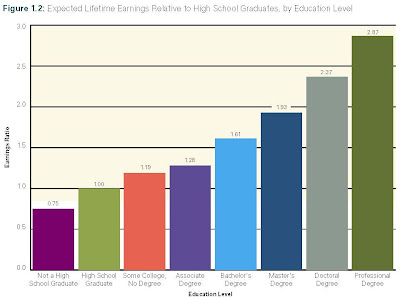
This is a lot of money, however if you view education as an investment in your child's future the costs are reasonable. A 2007 College Board Study, Education Pays, states that

"During their working lives, typical college graduates earn over 60 percent more than typical high school graduates, and those with advanced degrees earn two to three times as much as high school graduates. Salaries are not the only form of compensation correlated with education level; college graduates are more likely than other employees to enjoy employer-provided health and pension benefits. More educated people are less likely to be unemployed and less likely to live in poverty. These economic returns make financing a college education a good investment."

As your degree level increases, so does your total expected lifetime earnings. A master's degree (MBA,eg) is worth 93% more than a high school degree, a doctoral degree (PHD, eg) is worth 137% more, while a professional degree (MD, JD, eg) is worth 187%.
Below is a list of common ways to save for college. Each section will provide a brief summary, along with pros and cons of the methods.

Coverdell Education Savings Account

The Coverdell ESA allows you to make an annual non-deductible contribution to the savings account, which grows federally tax free. Withdrawals for qualified education expenses from the account are also tax free, in most cases. This account is similar, at least from a tax standpoint, as a Roth IRA. The money in the account can be used for accounts can be set up with most banks, brokers or mutual fund companies. This type of account lets you pay for elementary and secondary school expenses, along with other qualified education expenses.

Pros:

  • Flexibility & Investment Choices - can set up ESA with most banks, brokers or mutual fund companies. You can pick your investment choices.
  • Expenses - may be lower than in some state 529 plans.
  • Qualified Education Expenses - include tuition (K-12 and college), fees, tutoring, books, supplies, related equipment, room and board, uniforms, transportation, extended day programs, computers, Internet access.
  • Financial Aid - are treated the same as 529 Savings Plans for financial aid purposes (5.6% counted as a parent's asset).
  • Transferable - funds maybe transferred to other members of your family as long as the meet the age restrictions below.
  • Fees - typically are lower with this type of account.

Cons:

  • Contribution Amount - a total of $2,000 a year per beneficiary.
  • Earnings Restrictions - for modified adjusted gross income levels $95,000 to $110,000 (single) or $190,000 to $220,000 (married filing jointly), contributions will be limited. Over $110,000 (single) or $220,000 (married filing jointly), contributions are not allowed.
  • Age Restrictions - beneficiaries must be under the age of 18 and funds must be used by 30 years old.
  • Market Risk - since money is invested in stocks, bonds or mutual finds, the account could always be worth less than the contribution amount due to market risks.

529 Savings Plan

A 529 Savings Plan, or Qualified Tuition Program (QTP), works similarly to a Coverdell ESA, with some significant differences. A main difference is that these plans are set up by the states and administered by third parties, mainly mutual fund companies. In some states the contributions made to the account can be deducted from state income taxes. The plan will only cover qualified educational expenses for post-secondary education (college), but allows for higher contribution amounts

Pros:

  • Taxes - possible deduction on state income taxes.
  • Contribution Amount - up to $300,000 per beneficiary in many states.
  • Earnings Restrictions - None to very few depending on the state.
  • Age Restrictions - None to very few depending on the state.
  • Financial Aid - if account is owned by parent, the assets are assessed at a maximum rate of 5.64% in determining a student's Expected Family Contribution.

Cons:

  • Flexibility & Investment Choices - stuck using plans set up by the states. Most plans have limited investment choices.
  • Fees - typically higher than over college savings plans.
  • Taxes - can get complicated if contributions exceed the annual gift-tax exclusion of $12,000 per person.
  • Market Risk - since money is invested in stocks, bonds or mutual finds, the account could always be worth less than the contribution amount due to market risks.

529 Pre-Paid Plan

A 529 Pre-Paid Plan, or Qualified Tuition Program (QTP), allows families to purchase tuition at a public college at current cost. There are two types of pre-paid plans, a contract plan and a unit plan. A contract plan lets you purchase contracts for one to five years of tuition. A unit plan let you purchase 'units' which could be equal to credit hours or a percentage of a years tuition. Contributions can be made either as a lump sum or over a period of time.

Pros:

  • Market Risk - none,you are guaranteed by the state to at least match in-state tuition increases.
  • Transferable - most programs allow funds to be transferred to private or out-of-state schools. You are responsible for paying the difference in tuition rates.

Cons:

  • Flexibility - stuck using the state plan, geared towards state schools and often restricted to in-state residents.
  • Refund/Cancellation Fees - can be required to pay high penalties to cancel plan.
  • Qualified Education Expenses - limited to tuition and fees in most states.
  • Financial Aid - may significantly impact the ability to secure financial aid.

UTMA/UGMA

A uniform Transfer to Minors Act or Uniform Gifts to Minors Act accounts are an account set up on behalf of a minor. The child is the owner of the account upon reaching the 'age of majority'. so they can do as they please with the money. Their plans for the money may not include college.

Pros:

  • Earnings Restrictions - none.
  • Flexibility & Investment Choices - can set up a UTMA/UGMA with most banks, brokers or mutual fund companies. You can pick your investment choices.
  • Taxes - account is taxed at the child's income tax rate.

Cons:

  • Control - Once child reaches age of majority, they control the money.
  • Taxes - can get complicated if contributions exceed the annual gift-tax exclusion of $12,000 per person.
  • Financial Aid - account is owned by student, the assets have a larger impact on financial aid eligibility. Could make it more difficult to secure financial aid.
  • Irrevocable - money to fund to account is deemed an irrevocable gift and can not be transferred back to the parent.
  • Legal - these accounts require more legal understanding than other types of accounts. This link has a good explanation of UTMA/UGMAs.

This list is not exhaustive and there are other savings methods that could be used to save for college. Most of these other are not specific to saving for education, and do not have some of the same benefits as those listed above.

Three critical points to take away from this post:

  1. Start Early - As with any savings goal, the earlier you start the better. There are tons of articles and studies out there illustrating this point.
  2. Not One Account for All - You should evaluate which account is best for you. In some cases a single type of account may not be the best
  3. Your Retirement - Don't short change your retirement accounts to fund your child's education. Worse case, your child has to take out student loans to attend school. In the long run paying back the loan will be cheaper than having to fund a parent's retirement.

Source
http://www.collegeboard.com/parents/csearch/know-the-options/21385.html
http://www.collegeboard.com/prod_downloads/about/news_info/trends/ed_pays_2007.pdf
http://finance.yahoo.com/college-education/article/101867/A_Crash_Course_in_College_Savings_Plans
http://www.irs.gov/publications/p970/index.html

Helpful Links
http://www.collegeboard.com/parents/pay/
http://www.finaid.org/
http://www.finaid.org/calculators/costprojector.phtml

New Mortgage Product

This will be the last post on the home market and mortgages for a while, but saw an article {$$$} in the WSJ last week on a trend were home owners are abandoning their homes & mortgages as home values decrease.

"As home prices plummet, growing numbers of borrowers are winding up owing more on their homes than the homes are worth, raising concerns that a new group of homeowners -- those who can afford to pay their mortgages but have decided not to -- are starting to walk away from their homes."

"Many are speculators who had planned to quickly flip the home, but others appear to be homeowners who had second thoughts about their purchase."

"Some borrowers feel they have no good alternative. A tight credit market has made it tough for would-be sellers to find buyers or for borrowers looking to lower their mortgage costs to refinance."

"Other borrowers are walking away in frustration because they can't arrange a workout with their lenders, says D.J. Enga, director of outreach services for Auriton Solutions, which counsels homeowners nationwide. Mr. Enga expects that 10% to 15% of the roughly 4,000 callers counseled this month by Auriton, of St. Paul, Minn., will walk away from their mortgages."

"Some financial advisers are even encouraging homeowners who are upside down to consider foreclosure, which they see as a purely financial decision with limited negative consequences. YouWalkAway.com, a Web site started in January that offers foreclosure counseling to homeowners, advises that borrowers who default on one mortgage can typically get another mortgage between two and four years after a foreclosure. Then, "before you know it, you will have this behind you and a fresh start!" the site says."


I think the mortgage industry is missing a great way to increase market share. They can offer a new loan product. It comes with a slightly higher interest rate but allows you the flexibility to walk away from it. In the past they've offered loans where you could pay want you wanted and ones in which you did not have to show proof of income. This is next logical step.

Source
http://online.wsj.com/article/SB120424677934501611.html

March 1, 2008

Home Foreclosures Topping Home Sales

New York Times is reporting that in some parts of the country homes are going into foreclosure in larger numbers than homes being sold.


During January, it was reported this week by RealtyTrac, there were 153,745 initial foreclosure notices sent out in the United States. That dwarfed the 43,000 total sales of newly built single-family homes and amounted to nearly half the total sales figure, which includes sales of existing homes and condominiums.

In the West, however, the picture was much worse. There the number of sales was barely higher than the number of foreclosure notices. It appears that in the most heavily affected states the sales totals lagged behind the number of foreclosure notices.

Moreover, the volume of foreclosures is especially high in some states. In California, RealtyTrac reports, nearly a quarter-million properties were subject to some legal action related to foreclosure in 2007. Not all those foreclosures were completed, of course, either because the process dragged into this year or because the homeowner managed to sell the house or come up with money to make the missed payments. But those foreclosure moves affected 1.9 percent of the living units in the state — or 1 in 52 homes.
I am no economist or realtor but his trend can't be good for people trying to sell homes. The influx of foreclosed homes will end up putting pressure on home owners looking to sell. They will either take their home off the market or sell at a much lower price, which will perpetuate falling home values.


Source:
http://www.nytimes.com/2008/03/01/business/01charts.html?_r=1&oref=slogin